
Running a Sex Offender Check in Asotin County
The free Washington Sex Offender Public Registry, or WASOR, is the main public source for Asotin County sex offender information. The Washington Association of Sheriffs and Police Chiefs administers the OffenderWatch system with state funding. Search controls support a particular-person lookup as well as county, city, ZIP, address, and map-based review. Public disclosure depends on risk level and registration status, so an empty result does not always mean no registration exists.
The Asotin County Sheriff's Office is the local authority for in-person registration and law-enforcement verification. It is also the right fallback for a specific request about Level I information that is not broadly posted. For a person who may have moved across a state line, use the national registry after WASOR. Keep each source in its proper role.
Asotin County Hundred-Block Search
Washington law requires registry search capability by county, city, ZIP code, last name, and hundred-block address. A hundred-block display gives an area, not a precise home number. WASOR can show results on a map or list, which makes it useful for awareness near an Asotin or Clarkston address. Do not read the pin as live tracking. The record reflects the latest local registration data submitted to the system.
Prepare a last name for a person search or a complete local address for an area search. If several profiles appear, compare the public photo, aliases, physical description, conviction information, and risk level. Never identify a person from a name alone. The profile's correction or tip control is the proper way to flag a possible error or compliance concern.
Searching the Washington Sex Offender Public Registry
WASOR supplies separate routes for a name and a place. Search by the narrowest reliable detail, then widen only if no result appears. The registry is free and should not be replaced by a commercial people-search tool.
- Open WASOR and review the site's conditions for lawful use.
- Choose a last-name search or enter an Asotin County location, city, ZIP code, or address.
- Review the map and list, then open a likely profile and compare public identifiers.
- Confirm local questions with the Asotin County Sheriff's Office and use the profile tip control for suspected noncompliance.
| Field or control | Type | Required | Notes |
|---|---|---|---|
| Location or address | Text and map | One search route | Supports hundred-block and area review |
| City | Text or filter | No | Use Clarkston or Asotin |
| County | Select | No | Choose Asotin County |
| ZIP | Text | No | Narrows an area search |
| Last name | Text | No | Finds a particular public profile |
| Map or list | View control | No | Changes how public results display |
| Email alert address | Registration input | No | Monitors an address confidentially |
Asotin County Registry Address Alerts
OffenderWatch permits confidential registration of multiple addresses for email alerts. The service can notify a subscriber when a publicly disclosed Level II or Level III registrant moves near a monitored Asotin County address. This is more useful than repeating the same map search each week. It also keeps the subscriber's monitored addresses out of the public profile.
The WASPC sex-offender information page explains Washington's public registry and directs residents to the alert tool.
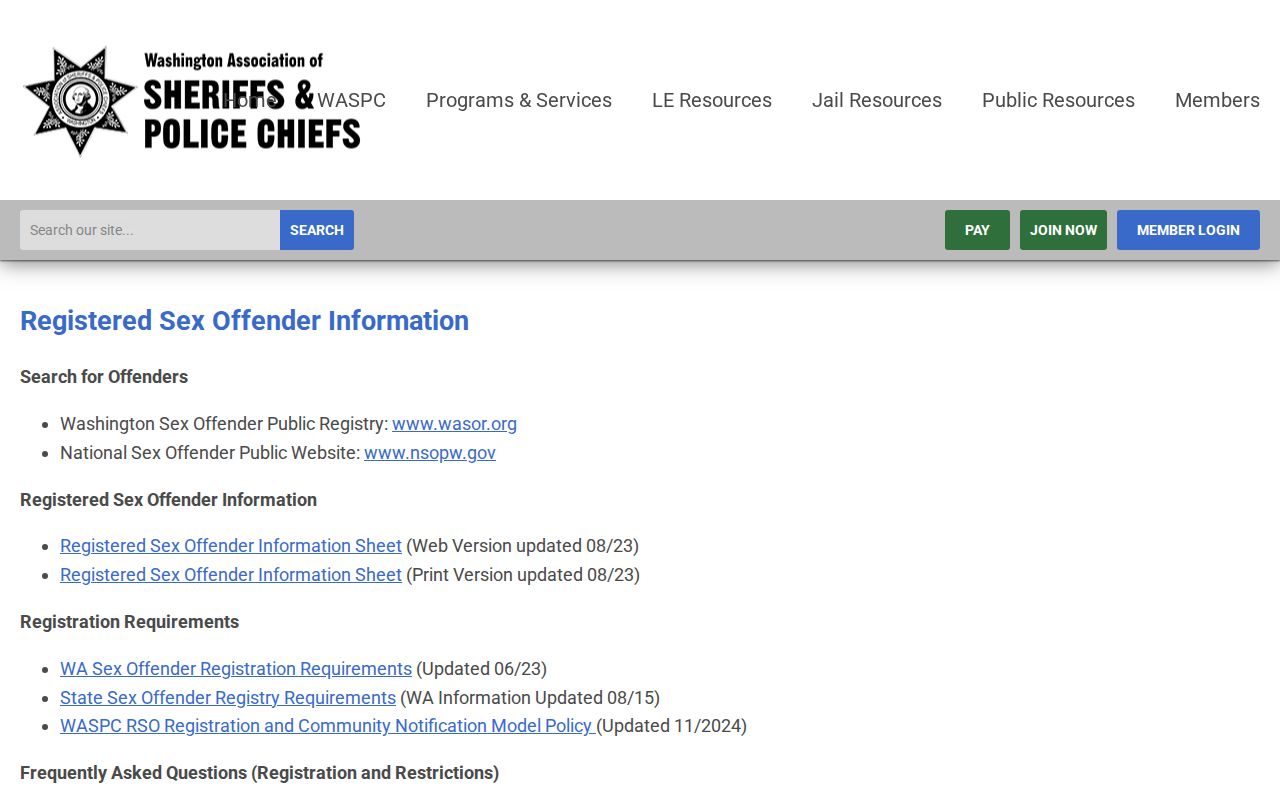
An alert is a prompt to review the official profile. It does not establish that the registrant is at the mapped location at a given moment.
What a Registry Profile Shows
A public Asotin County registry profile presents community-notification facts, not a full criminal history or court file. State law calls for key Level III details such as the name, relevant convictions, hundred-block address, physical description, photograph, and map. Other public profiles may include similar fields when disclosure rules apply.
| Name and aliases | Public identity names linked to the registration record. |
|---|---|
| Photo and description | Image, physical traits, and potentially scars, marks, or tattoos. |
| Mapped address | A hundred-block location rather than proof of real-time presence. |
| Conviction details | Relevant offense and conviction information disclosed for notification. |
| Risk level | Level I, II, or III assessment used to guide public disclosure. |
| Registration status | Compliance or other public status, subject to the latest local update. |
Do not expect victim details or a complete list of every criminal case. For the filed charge, judgment, and sentence, use the Asotin County criminal court case record held by the clerk.
Asotin County Level I Fallback
Level I means a low assessed risk for notification purposes. Washington generally limits broad Level I disclosure to law enforcement, schools, and certain specific requests. A Level I registrant may appear publicly when noncompliant or when lacking a fixed residence, but many will not appear on the ordinary map. This is a common reason an Asotin County search may look incomplete.
For a specific, lawful inquiry, contact the Asotin County Sheriff's Office at 127 2nd Street, Asotin, or call 509-243-4717. Give enough detail to identify the question without assuming the portal should disclose a record. The sheriff applies Washington's risk-level disclosure rules and can explain what may be released. General police or court files remain separate records.
Registration Requirements and Levels in Washington
Risk level controls the scope of community notification. It does not set the length of registration. Level I is low risk, Level II is moderate risk, and Level III is high risk. Under the funded local verification program, law enforcement verifies Level I registrations every 12 months, Level II every six months, and Level III every three months. Those are agency verification frequencies, not a universal schedule for every registrant's in-person reporting duty.
| Risk level | Public visibility | Local verification |
|---|---|---|
| Level I | Limited sharing; public portal in specified status cases | Every 12 months |
| Level II | Public portal and notice to relevant local groups | Every six months |
| Level III | Public portal and broad sheriff notification | Every three months |
Registration duration instead follows the offense category and statutory rules. The adult base period is lifetime for a Class A felony, 15 years for a Class B felony, and 10 years for a Class C felony or specified offense. The 15-year and 10-year routes require that many consecutive years in the community without a disqualifying offense before registration can cease.
| Adult offense category | Base period | Condition noted in law |
|---|---|---|
| Class A felony | Lifetime | Lifetime base duration |
| Class B felony | 15 years | 15 consecutive qualifying community years |
| Class C felony or specified offense | 10 years | 10 consecutive qualifying community years |
Juvenile rules changed in 2023 and depend on age and offense. The adult duration table must not be applied to a juvenile record.
Asotin County Offender Verification
Washington law requires a qualifying person to register in person with the sheriff in the county of residence. A nonresident may also have duties in a county where the person attends school or carries on a vocation. Release from custody triggers its own registration steps. The Asotin County Sheriff's Office conducts the local verification work and forwards registration information to Washington State Patrol.
The state transmission can include registration data, a photograph, fingerprints, risk level, and an address change. The statutory forwarding period is five working days. That flow explains why a public profile may lag a local change. If an address looks wrong, send the concern through the profile's tip or correction control or contact law enforcement. Do not visit the address or confront anyone.
Asotin County and National Registry Search
WASOR covers Washington's public layer. The U.S. Department of Justice National Sex Offender Public Website searches participating state, territorial, and tribal registries. It is a useful second step when a person may have crossed the Idaho line near Clarkston or lived in another jurisdiction. NSOPW does not replace the Asotin County Sheriff's local registration role.
The official national search page shown below makes the cross-state boundary clear.
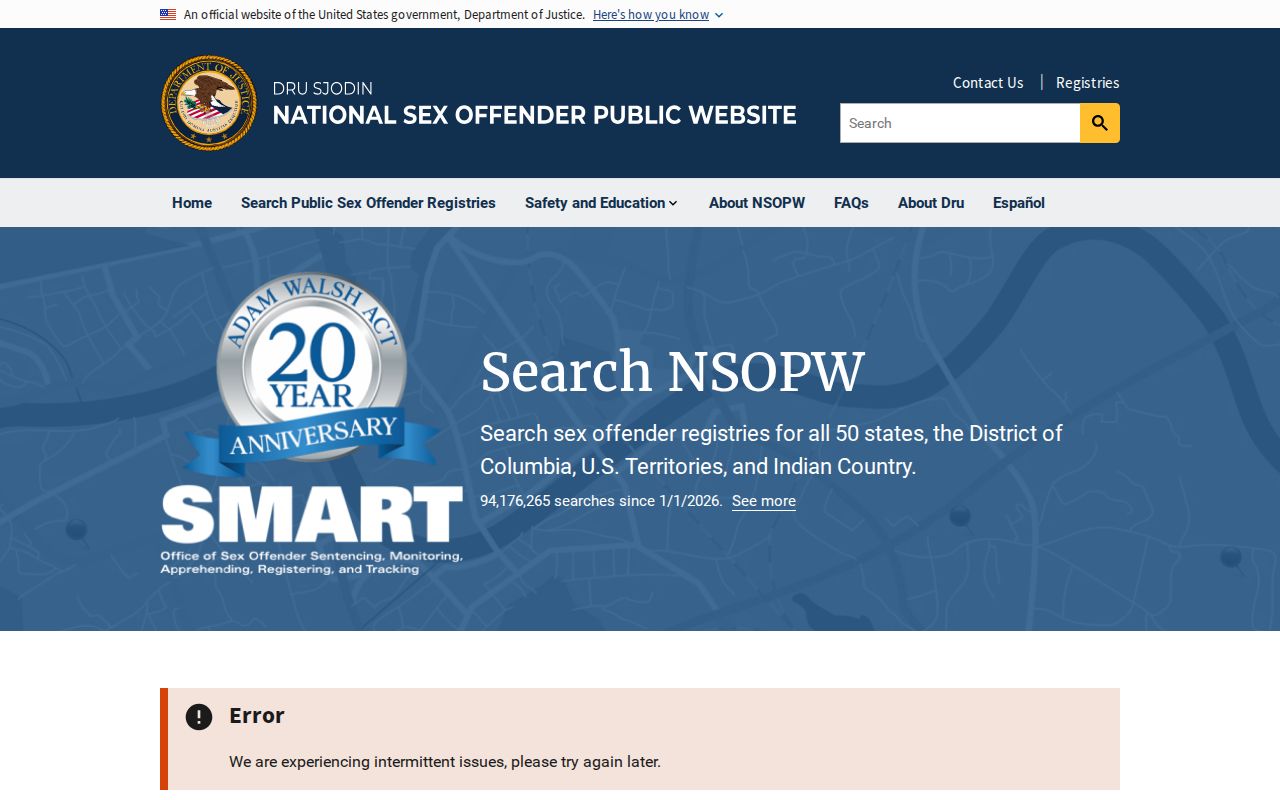
Compare a national result with the source jurisdiction's profile. Each registry applies its own disclosure rules, and one state's map cannot prove current compliance in another.
Lawful Use and Community Notification
Washington's registry exists for community awareness and safety planning. Under RCW 4.24.550, disclosure increases with assessed risk. Level II notice can reach schools, daycares, libraries, groups serving vulnerable people, and nearby residents. Level III permits broader community notice by the sheriff. A profile is still only one source and should be read with care.
Use registry information lawfully: RCW 4.24.550 governs disclosure, and WASPC warns that threats, vandalism, violence, or harassment against a registrant or family can lead to arrest and prosecution.
Report suspected noncompliance through the official profile control or local law enforcement. Do not confront a registrant. Washington does not have a blanket statewide distance rule that bars every registrant from living near the same types of places. A court order or supervision condition may impose limits in an individual case, so a reader should not invent a violation from the map alone.
Community notice also differs from a complete Asotin County case history. Risk level reflects a notification assessment, while the registration term follows the qualifying offense and statutory duration rules. Compliance status can change after the local office submits an update. Those distinctions matter when a family reviews a map, receives an address alert, or sees a profile shared in the community. Check the current WASOR entry, note when the information was last updated if that field is shown, and direct any factual concern to the sheriff or the registry's correction channel.